
Product Management Role Just Changed Forever. Here's the New Playbook.
How to survive and thrive as the “Full Stack PM” — plus a new PRD template built for the age of AI prototyping

Two years ago, writing a great PRD was enough. Today, the Product Manager who shows up with a working prototype wins the room.
Something fundamental shifted in 2025. It wasn’t just another wave of tooling, it was a redefinition of what product managers are expected to do and deliver.
If you’re still leading with documents instead of demos, you’re losing ground to a new breed of PM who builds first and writes later.
This article breaks down exactly what’s changed, what it means for your career, and introduces a new Product Requirements Document (PRD) format designed for PMs who now prototype.
What Actually Changed
The shift has three layers, and most PMs are only aware of one of them.
Layer 1: AI killed the PM generalist
The traditional PM who writes specs, runs stand ups, manages stakeholders, and owns the roadmap is being squeezed from both ends. AI handles the documentation. Engineers are shipping faster. And executives want to see working product, not slides.
As one CPO put it: “Before it would take days to write feedback and requirements. Now you’re taking 15 minutes to scaffold something that’s 80% good and 45 minutes to sharpen it and ship it.”
The generalist PM who can’t build or prototype is becoming the middle manager equivalent of the pre-digital photographer. The tools changed. The expectation changed. The job changed.
Layer 2: The Full Stack PM is now the baseline
In 2025, something called the “Full Stack PM” emerged: product managers who can wireframe in Figma, prompt AI into functional prototypes with Lovable or v0, read a pull request, and sit in code reviews without needing a translator.
This doesn’t mean PMs should be coding production features. It means the expected surface area of the PM role now includes the ability to build enough to prove a concept, earn engineering respect, and compress feedback cycles from weeks to hours.
Layer 3: The 90-day clock
At AI-first companies, the new reality is brutal and clarifying: you have 90 days to experiment, build, ship, and collect real customer feedback. Everything else is secondary.
The old advice about spending your first 90 days in listening mode, scheduling coffee chats, and learning the product? That made sense when product cycles lasted 18 months. In a world where AI can help you prototype in hours, 90 days is an eternity.
The PMs who thrive in this environment are those who build first, learn fast, and let the prototype do the persuading.
The New PRD: Built for PMs Who Prototype
The classic PRD format was designed for a world where documentation preceded building. You wrote the spec, design built wireframes, engineering estimated, and the cycle took weeks.
That world is gone. Today’s PM often has a working prototype before the PRD is finished. The document needs to reflect that reality and not pretend it doesn’t exist.
What follows is a new PRD structure designed specifically for the PM-as-prototyper workflow. Copy it, adapt it, make it yours.
The Prototype-First PRD Template
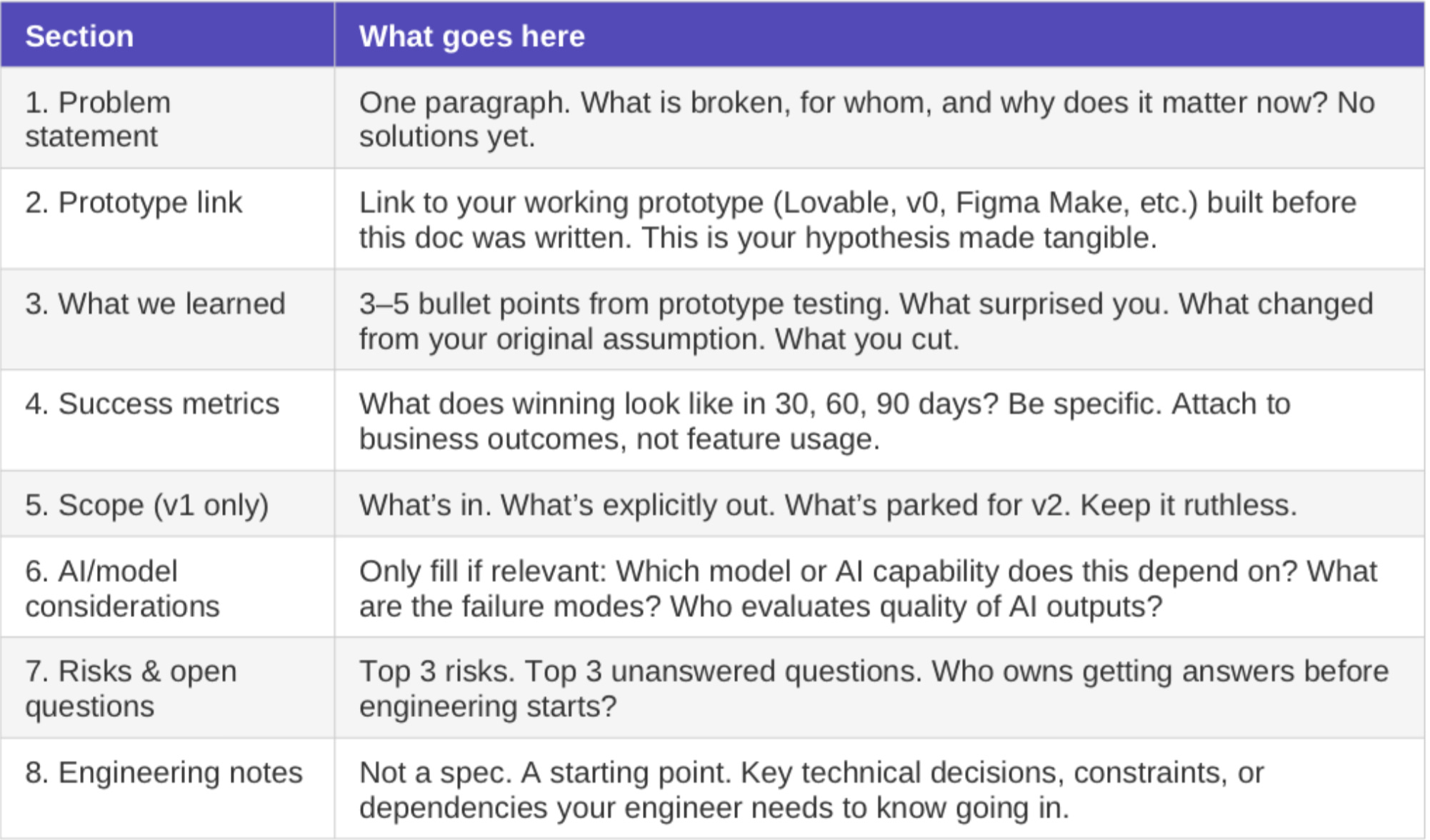
It’s not a spec, it’s a starting point. Key technical decisions, constraints, or dependencies your engineer needs to know going in.
The prototype link in section 2 is the most important change. It transforms the PRD from a persuasion document into a validation document. You’re not asking engineering to trust your idea, you’re showing them what users already responded to.
How to Use This in Practice
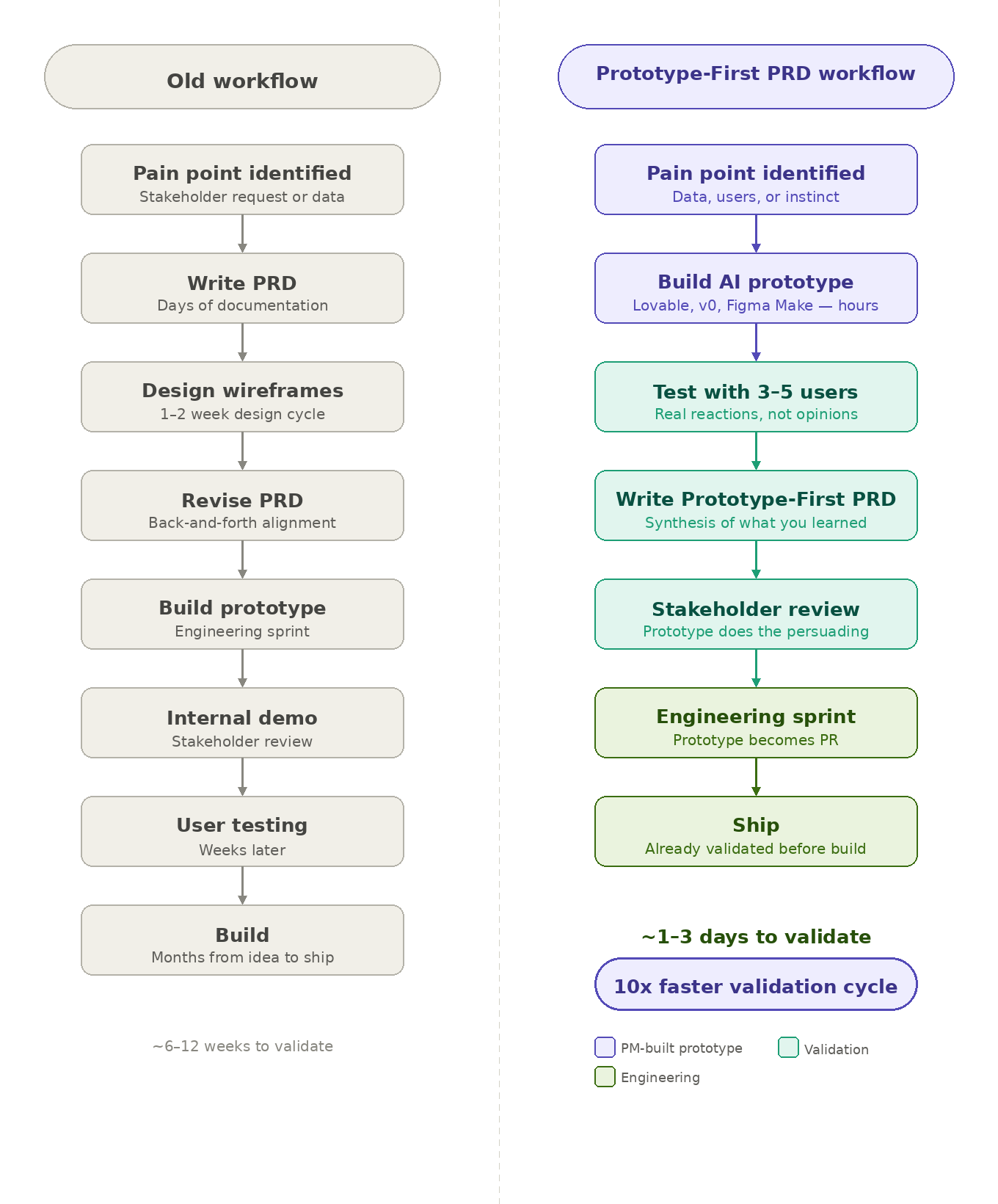
Here’s the workflow this template is designed around:
Identify a pain point (from user interviews, data, or your own product instincts)
Build a rough prototype in 1–3 hours (using Lovable, v0, Figma Make, or similar)
Share it with 3–5 real users or stakeholders (watch them use it, don’t explain it)
Fill in sections 3–8 of the PRD based on what you observed
Present the prototype + PRD together (the prototype is your opening argument)
What This Means for Your Career
This shift is uncomfortable for experienced PMs. It requires learning new tools, sitting with uncertainty longer, and doing work that used to belong to designers or engineers.
But here’s the upside: PMs who prototype are irreplaceable in a way that PMs who only write specs are not. The value isn’t just in the prototype itself, it’s in the judgment you develop by building, testing, and killing your own ideas before they cost the company anything.
That judgment, knowing what’s worth building before a single engineering sprint is allocated, is the moat that AI cannot cross.
The PMs who thrive in 2026 and beyond are not the best writers. They’re the best at reducing the cost of being wrong.
If this article resonated, forward it to one PM on your team. They’ll thank you.
Next issue: Executive Presence - why most Product Managers communicate down when they should be communicating up.